

I make things. Some are serious. Some are funny. Most are curious. If you’re interested in history, community, humor, stories, music, and the odd corners of human nature, I think you’ll find something here that’s worth your time.
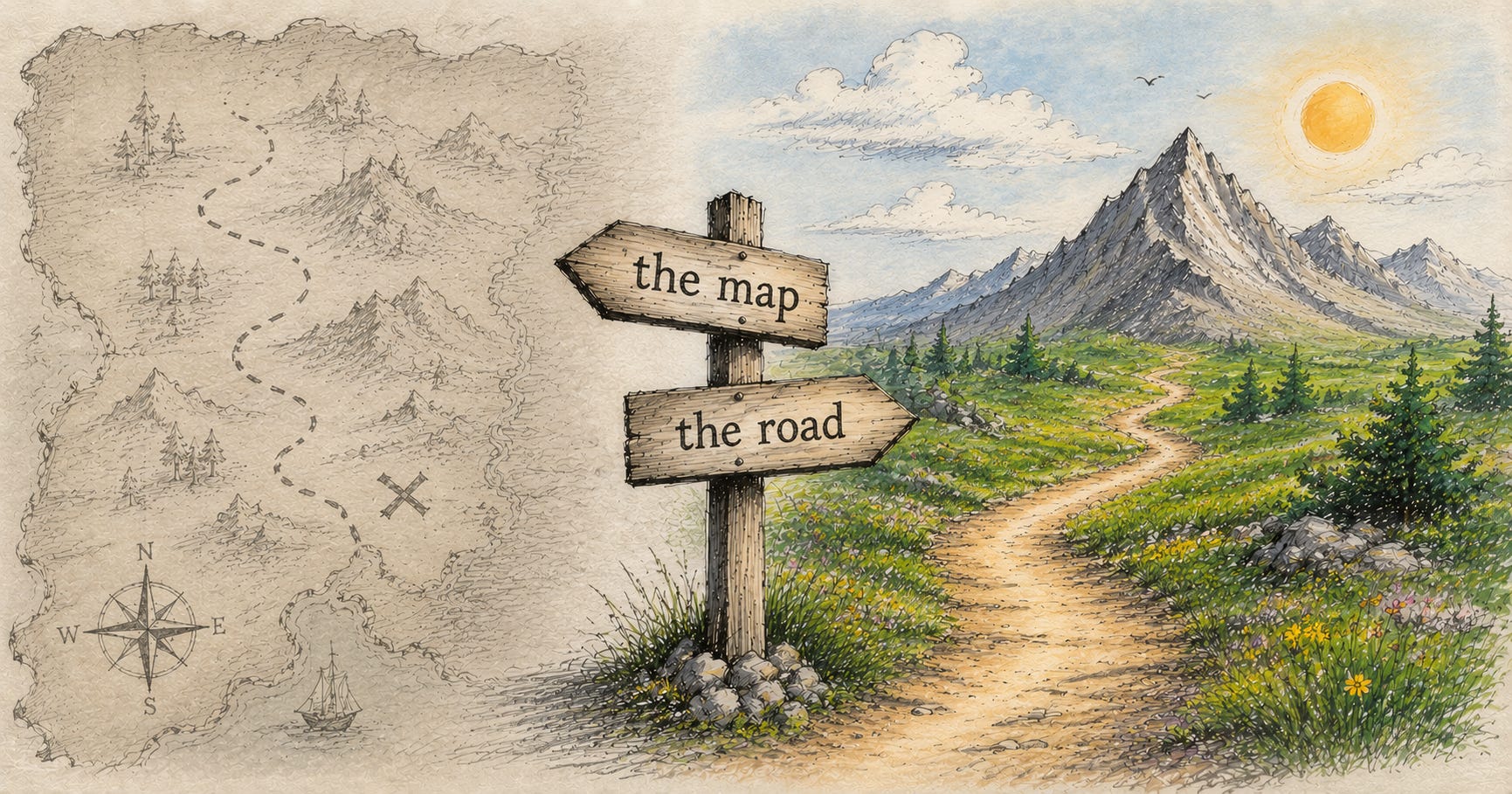
THE MAP
Honey, the map is not the territory.
It’s information, not the whole story.
A legend can tell you what it all means,
But it ain’t gonna tell you what you’ll see.
Symbols are representative, their individual meaning tentative.
Every word contains a new direction.
Form your words with clear intention.
Maps and signs, they can show the route.
They don’t show what the road’s all about.
It takes one word to begin the quest.
Walking the path teaches us the rest.
Every sign stands as representation.
Requiring thought and interrogation.
Meaning comes from interpretation.
And leads you right to initiation.
Every choice leads to a new situation.
Every action creates a new variation.
Every word contains a new direction.
Form your words with clear intention.
Maps and signs, they can show the route.
They don’t show what the road’s all about.
It takes one word to begin the quest.
Walking the path teaches us the rest.
Meaning doesn’t exist inside a vacuum.
Context leads to a whole different truth.
Every meaning contains an alteration.
A setting-specific personal extrapolation.
When setting changes, so does the use.
Meaning changes with your point of view.
Every word contains a new direction.
Form your words with clear intention.
Maps and signs, they can show the route.
They don’t show what the road’s all about.
It takes one word to begin the quest.
Walking the path teaches us the rest.
Words don’t end with you and me.
They’re sewn into the fabric of reality.
Listen closely to what our words can do.
Know that understanding them is up to you.
Spoken words can begin obligation.
Words in unity can end separation.
Shared agreement gives words strength.
Keeping us on the same wavelength.
You can speak peace and make it true.
Words can reshape the world anew.
Every word contains a new direction.
Form your words with clear intention.
Maps and signs, they can show the route.
They don’t show what the road’s all about.
One word can point to a whole new world,
But how do we see the whole picture, boys and girls?
By walking the path!
Not every map shows the mountain.
Not every sign’s a full accounting.
Words can lead you toward a meaning.
But you decide just what you’re seeing.
THE TAKEAWAYS
Alfred Korzybski and General Semantics
Alfred Korzybski introduced the idea that “the map is not the territory,” arguing that words, symbols, and mental models are only representations of reality, not reality itself. Just as a map can help us navigate without containing every tree, mountain, or river, language helps us understand the world while inevitably simplifying it. For writers and rhetoricians, this is a reminder that language can only point toward an experience. Strong writing uses words as guides, helping readers discover meaning without confusing the description with the thing being described.
Language Directs Attention
Language does more than describe reality. It directs our attention, emphasizing certain ideas while downplaying others. Every word carries intention, shaping how an audience understands a situation before they have fully processed it. Maps can show us where to go, but they cannot replace the experience of making the journey. Likewise, good writing provides direction rather than certainty, inviting readers to engage with ideas and discover meaning through experience instead of simply receiving information.
Charles Sanders Peirce and Semiotics
Charles Sanders Peirce developed a theory of semiotics that explains meaning as something that emerges through interpretation rather than existing inside words themselves. A sign represents something, but each reader or listener must interpret that sign, and those interpretations often lead to actions that create new meanings and experiences. Peirce called this ongoing process semiosis. For writers, communication is completed not when words are written, but when readers construct meaning. Effective rhetoric anticipates interpretation and recognizes that audiences actively participate in creating meaning.
Ludwig Wittgenstein and Context
Ludwig Wittgenstein argued that the meaning of a word comes from how it is used within a particular context rather than from a fixed definition. The same sentence can communicate different things depending on who says it, when it is said, and the circumstances surrounding it. Context changes interpretation, and interpretation changes meaning. For writers and speakers, this emphasizes the importance of audience, purpose, and situation. Great communication is not just about choosing the right words. It is about choosing the right words for the right moment.
Language as a Social Agreement
Language is a shared system that belongs to communities rather than individuals. Linguists like Ferdinand de Saussure and philosophers like John Searle argued that words only work because people collectively agree on their meanings. Many aspects of society, including laws, money, governments, and institutions, exist because communities recognize the meanings created through language. Writers and rhetoricians rely on these shared conventions to communicate effectively while also challenging audiences to see familiar ideas in new ways.
J. L. Austin, John Searle, and Speech Act Theory
J. L. Austin and John Searle showed that some utterances do more than describe reality. They create it. A promise creates an obligation. An apology begins reconciliation. A judge’s sentence or a marriage vow changes the social world simply by being spoken under the right circumstances. This illustrates that language is not merely descriptive but performative. In rhetoric, words are capable of establishing relationships, creating commitments, and inspiring collective action.
Meaning Is Completed by the Audience
Every representation leaves something out, and no writer can completely control how their words will be understood. Readers bring their own experiences, perspectives, and assumptions to every text they encounter, making interpretation an active process rather than a passive one. Writers can guide audiences toward meaning, but they cannot dictate it. Communication is ultimately a collaboration between the author, the text, and the reader, with meaning emerging through their interaction.


